Character creator
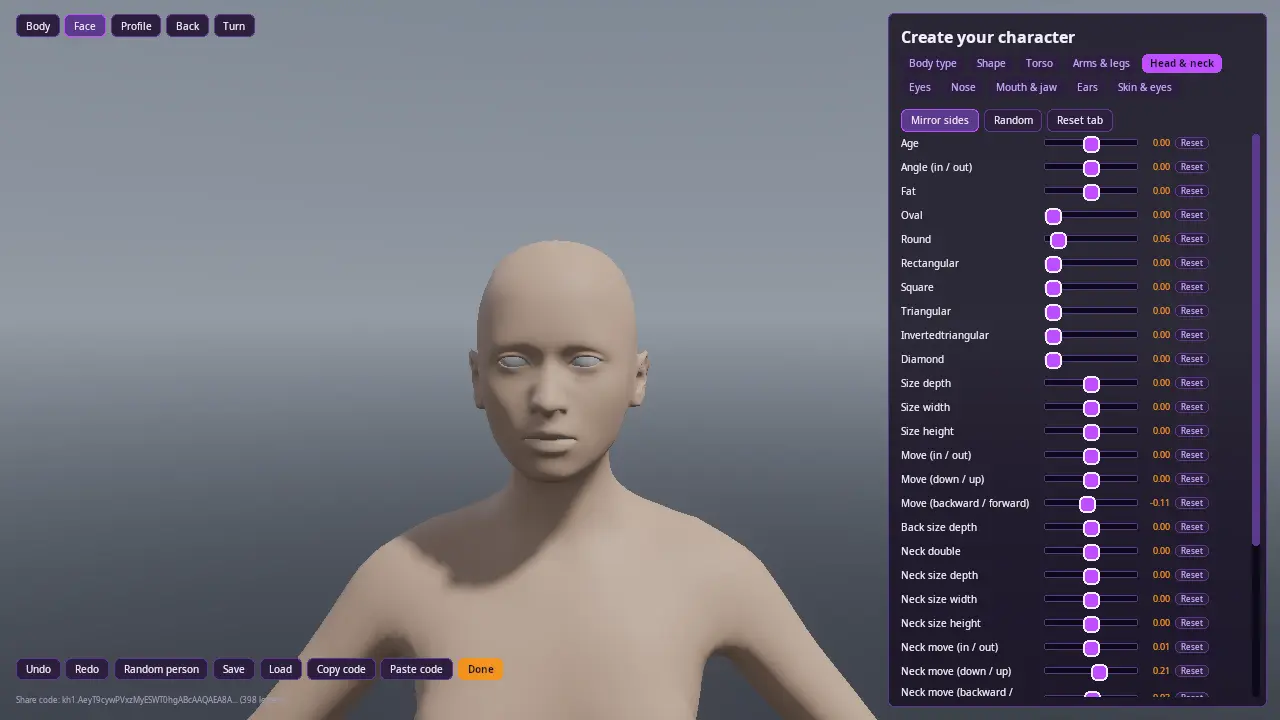
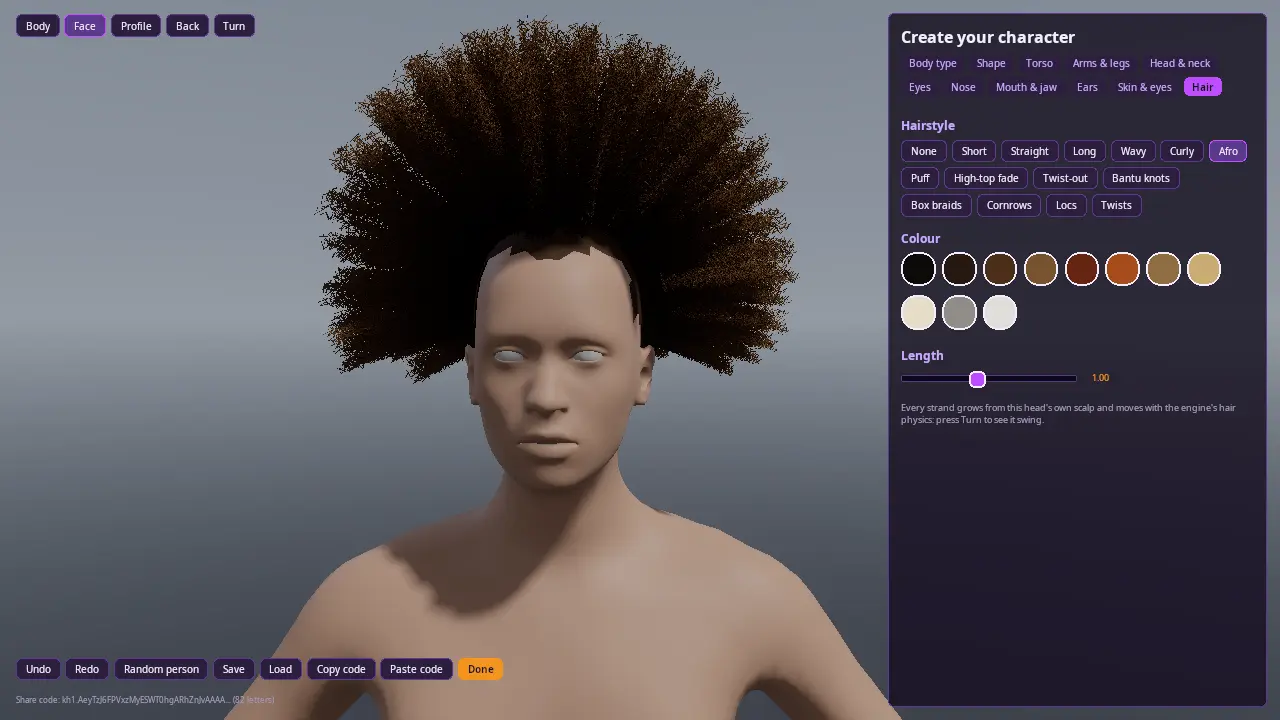
Make a realistic person with sliders: body type (gender, age, ancestry, muscle, weight, height, proportions), then the shape of the torso, arms and legs, head and neck, eyes, nose, mouth, jaw and ears, about 300 sliders in all, a skin tone, and hair: 14 hairstyles from short and long to an afro, box braids, cornrows and locs, 11 colours and a length, as real strands grown from this head's own scalp and moved by the engine's hair physics. The person is MakeHuman's CC0 human (docs/HUMANS.md), so every slider is a morph sculpted by artists, and the sliders blend the way MakeHuman's do.
The screen is kke::CharacterCreatorModule, an engine module, not code
that lives in this demo: a tennis game, a dress-up game or an RPG adds the
same module, hears onDone, and gets the finished person. This demo is
that module and nothing else.
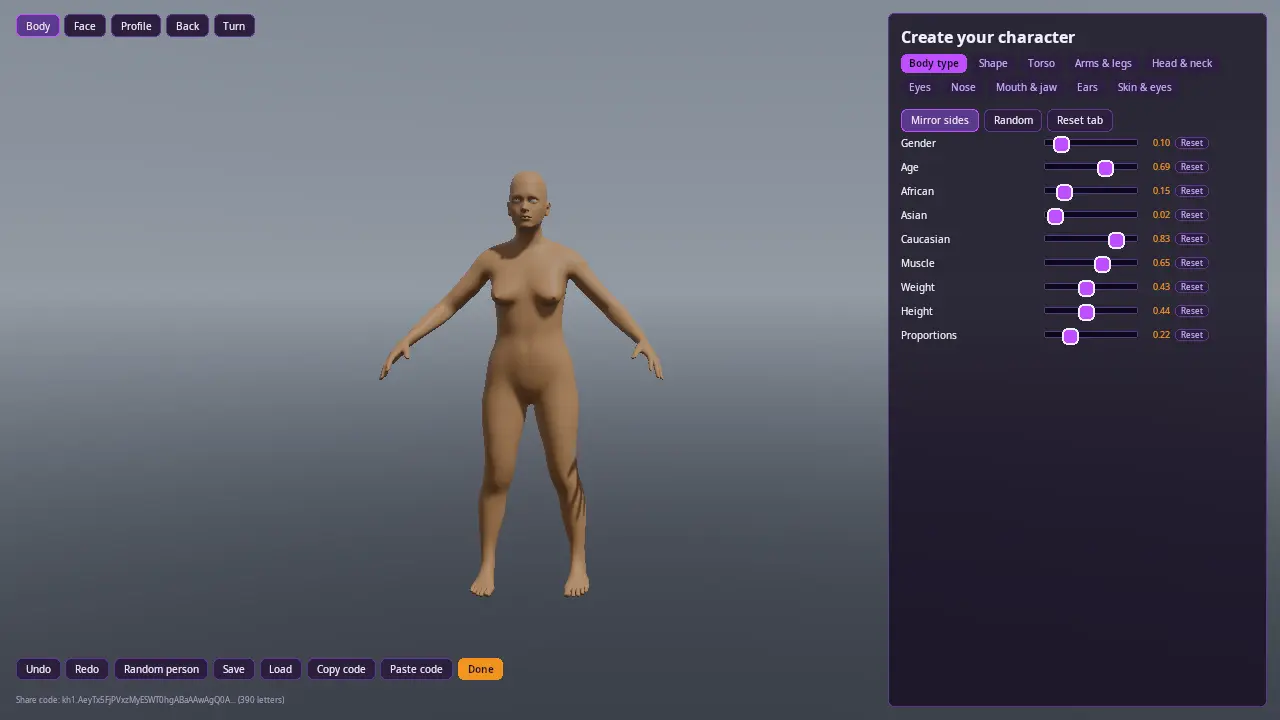
Run it: cd build/bin && ./character_creator.
| Do | How |
|---|---|
| Move a slider | Drag it |
| Turn the camera | Left drag beside the panel, or a controller's right stick |
| Views | Body, Face, Profile, Back |
| See the hair move | Turn: the figure spins and its hair swings out |
| Both sides at once | Mirror sides (on by default) |
Moving the sliders with a controller is not in yet.
Random randomises the tab you are on, Random person everything.
A random person stays believable: a third of the detail sliders move, and
only a little, because many sliders far out at once make a face nobody
has. Undo and Redo go back up to 100 steps (one step per drag).
Save and Load use character.kkhuman in the game's save folder.
Copy code puts the share code on the clipboard and Paste code
reads one.
How it is built
- One bake, then only vertices move. The body is baked once into an
ordinary model. While a slider moves,
Human::reshapemoves the same vertices andModelModule::setDeformedVerticesuploads them: no new model, no new GPU buffers.bakeSkinned()gives a game the finished body with bones and weights for the engine's GPU skinning, so in the game a custom person costs what any skinned model costs. - Multiplayer: values travel, not meshes. A look is slider values and
colours.
shareCode()packs them into a URL-safe string (kh1....), about 90 letters for a few changes and 250 for a random person; the other machines load the same pack and bake the same body. The player's own body usesquantised()values, rounded exactly like the code, so everyone sees the same vertices. A code made with another pack is refused, not misread. - Hair is the engine's strand hair (docs/HAIR.md) grown from the
body's scalp by
kke::hairOnHuman(docs/HUMANS.md "Hair"), simulated in aRigidWorldwhere the body is a mesh only hair and cloth feel. The scalp is painted the hair's root colour. 160 guide strands, a few thousand drawn hairs built on the GPU. - Saves are JSON (
kk-human, version 1) with MakeHuman's slider names, andlookFromMhmreads.mhmfiles from the MakeHuman app. - The screen is RmlUi:
assets/ui/character_creator/creator.rmlandcreator.rcss. Run withKKE_CREATOR_UI=<that folder>to use your copy, and press F5 to reload the stylesheet while the demo runs.kke_use_character_creator(TARGET)in CMake copies them and the human pack next to a game.
For CI and screenshots: KKE_CREATOR_TAB=nose, KKE_CREATOR_VIEW=face,
KKE_CREATOR_HAIR=afro (a hairstyle, empty for none), KKE_CREATOR_TURN=1
(start turning), and KKE_CREATOR_SELFTEST=1, which makes a random
person, sends it through a share code and back, and logs creator
self-test passed when the code comes back the same, the person stands on
the floor and its hairstyle is on its head.
Not yet
The plan's next steps, in order: animation (MakeHuman's rig onto the
engine's canonical bone names), skin textures, eye colour and brows,
clothes fitted with MakeHuman's .mhclo files with cloth physics for
loose garments, a credits screen for CC-BY assets, and facial
expressions (ENG-F25).