Cookbook
Recipes for making games with KKE, from your first line of Lua to pathfinding, procedural animation and inverse kinematics. Each one is a small, complete piece of working code with a picture of it running.
How to use a recipe
Most recipes are one Lua file. Make a game from the starter template
(Make your own game), start it, and save
the recipe into its scripts/ folder: it runs the moment you save, and
again every time you change it. Every recipe has a download link, and
works in the starter game's level as it is.
Some recipes are C++, in the cookbook game (games/cookbook, run it
as ./cookbook from build/bin). It is the starter game plus every common
camera and an animated mannequin; the pages quote its code.
The chapters go from simplest to most involved:
| Chapter | You'll learn |
|---|---|
| First steps | Variables, if, loops, functions and tables, each spawning something you can see; timers |
| Input | Your own controls, hold and release, reading the standard actions, binding keys and pads in C++ |
| Moving things | Tuning the character, a ball you steer, a pet that follows you, patrols, launch pads |
| Cameras | First person, third person, orbit, top-down, isometric, side-on, fixed and cinematic cameras; screen shake |
| Gameplay | Trigger zones and doors, shooting with rays, explosions, a full round with a HUD, a timer and a saved best |
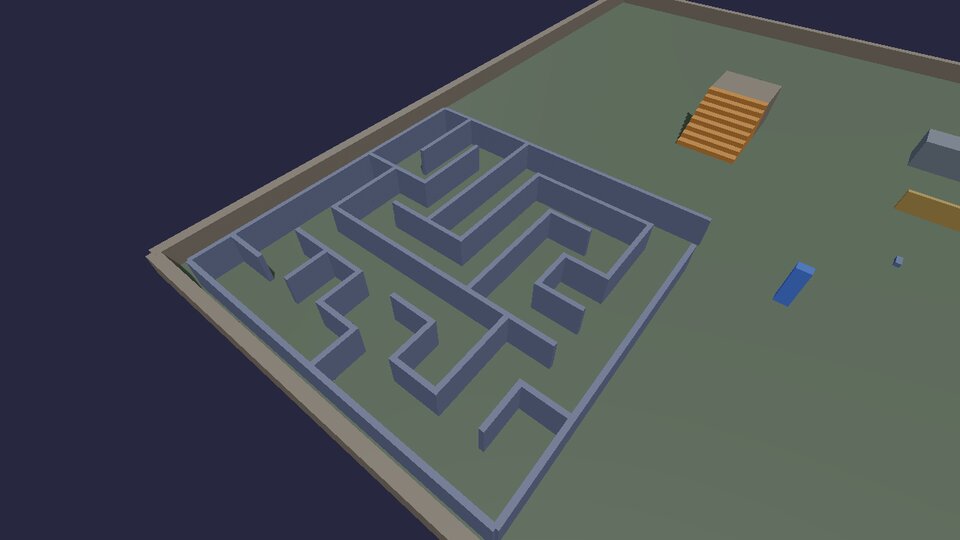
| Algorithms | Maze generation, terrain from noise, A* pathfinding, flocking |
| Animation and IK | Procedural motion, springs, two-bone IK, blend spaces, look-at and foot placement on a skeleton |
| Physics | Bounce and friction, things that really break, physics from C++ |
| Sound | Sound materials, impact sounds, playing your own |
| Multiplayer | Host and player scripts, messages, a shared scoreboard |
| Play to make | The same game logic three ways: pictures, a node graph, and Lua |
| C++ | Your own module, your own Lua bindings, testing your code |
New to Lua? It's a small language; Programming in Lua is the classic introduction, and the Lua API reference lists everything the engine adds. Scripting in Lua explains hooks, timers, hot reload and the sandbox.
Why the recipes don't go stale
Documentation is only useful when it's right. Every recipe here is checked by CI on every change to the engine:
- The Lua recipes are real files (
docs/cookbook/recipes/), shown on these pages as they are. CI starts the starter game headless with each one (tools/docs_site/run_recipes.py) and fails on any script error; the unit tests also compile every one of them. - The C++ on these pages is quoted from files that are compiled into the
cookbook game and the unit tests (
tests/test_cookbook.cpp), which run it and check it does what the page says. - The play-to-make Lua runs in the unit tests against the same building blocks the sandbox uses.
The screenshots come from the same runs:
tools/docs_site/run_recipes.py --shots takes a picture of each recipe
running and saves it here.