Procedural animation
Motion worked out every frame instead of played back from a clip: feet that find the ground, animals with any number of legs that walk, trot and gallop without a single walk clip, heads that turn toward what they notice, and bodies that stagger when hit and catch themselves (or don't).
Status (2026-09-27): done: the engine side, the play-to-make blocks (Shove, Look at, Look away) and
games/procedural_demoare on main and tested.
Everything lives in kke/ProceduralAnim.h
(the reference) on top of what was already there:
| Already in the engine | Where |
|---|---|
| Clips, blend spaces, crossfading state machine | kke/Animator.h |
| Two-bone IK, biped foot placement, retargeting | kke/AnimRig.h |
| Ragdolls (humanoid, quadruped), joint limits | kke/Ragdoll.h, RAGDOLLS.md |
| Secondary motion (tails, ears, soft bodies) | kke/JigglePhysics.h, JIGGLE.md |
| Locomotion controller (what moves the capsule) | kke/Locomotion.h, MOVEMENT.md |
Nothing here is new science. The algorithms are the standard published ones:
FABRIK for long chains (Aristidou & Lasenby 2011), the Raibert heuristic for
where a foot lands (Raibert 1986), gait phase tables from biomechanics
(Hildebrand; Alexander 1984, including the Froude number that tells every
animal when to change gait), and motor-driven active ragdolls exactly the way
Jolt's own JPH::Ragdoll::DriveToPoseUsingMotors does it (Jolt is already a
dependency; no new library was needed).
The layers, in order
Every piece is a layer that takes a kke::Pose and changes it, with a weight
so it can fade in and out:
Animator (clips)                      or the rest pose, for a creature with no clips
  -> blendPosesMasked / addPose       upper body waves while the legs walk; additive flinch
  -> ProceduralGait + applyGait       procedural legs          (or LegPlacer: clip legs on hills)
  -> LookAt                           head / spine toward a target
  -> solveTwoBone / solveFabrik       hands on things, tails, tentacles
  -> JigglePhysics                    secondary motion
  -> ActiveRagdoll                    physics follows all of the above; hits push it off
Legs for any animal: ProceduralGait
The controller (AI, player input, kke::Locomotion) moves the creature as a
point with a heading. ProceduralGait plans the footsteps: each foot stays
planted in the world until its turn in the gait, then swings in an arc to
where it will be needed next, found by asking the ground. The body rises and
settles with the terrain, pitches and rolls to its feet, bobs at push-off and
leans into turns.
#include "kke/ProceduralAnim.h"

// A dog-sized quadruped: 0.8 m long, 0.3 m wide, hips 0.5 m up.
kke::ProceduralGait gait(kke::makeLegs(4, 0.8f, 0.3f, 0.5f));

auto ground = [&](const glm::vec3& from, glm::vec3& hit, glm::vec3& normal) {
    auto h = physics->physicsRaycast(from, {0, -1, 0}, 3.0f); // any IPhysicsWorld
    if (!h.hit) return false;
    hit = h.point; normal = h.normal; return true;
};

gait.reset(bodyWorld, ground);                                // once, and after teleports
// every frame, after the controller moved the body:
gait.update(bodyWorld, velocity, turnRateDegrees, ground, dt);
for (int i = 0; i < gait.legCount(); ++i) {
    const auto& f = gait.foot(i);                             // f.position, f.normal, f.planted
    if (f.landed) footstepAt(f.position);                     // sound and dust
}
glm::mat4 drawnBody = gait.bodyPose();                        // for the torso / pelvis
Legs are numbered front to back, left then right: a biped is L, R; a
quadruped FL, FR, BL, BR (the same order as kke::QuadrupedBones); six legs
L1, R1, L2, R2, L3, R3; eight likewise. makeLegs(count, length, width,
hipHeight) lays out mirror pairs; a LegDesc per leg (hip, rest foot, upper
and lower segment lengths, in body space: +Z forward, origin on the ground)
describes anything else.
Gaits (kke::Gait): walk, trot, pace, canter, gallop, bound, pronk,
tripod, wave, and Auto, which picks from speed with the Froude number
v²/(g·hip height): quadrupeds walk below 0.5, trot to 2.5 and gallop above;
bipeds walk then run; six and eight legs wave then run on tripods. Because the
thresholds are relative to leg length, a pug and a horse both change gait at
the right speed for their size. Gaits change mid-stride without feet
teleporting: a leg finishes its swing before the new timing takes over.
Timing. A cycle is between cycleFast and cycleSlow pendulum periods of
the leg (2π√(L/g)), and never so long that a foot would have to drag further
than strideScale × leg length. Standing still, feet that ended up far from
rest (resettle) step back under the body, one gait beat at a time.
On a skeleton
For a rigged animal (the Quaternius farm animals, anything with
QuadrupedBones names) the same gait drives the bones:
auto chains = kke::quadrupedLegChains(model);                 // FL, FR, BL, BR
kke::ProceduralGait gait(kke::legsFromSkeleton(model, chains, modelToBody));
int hips = /* index of "Hips" */;
// per frame:
kke::Pose pose = animSet.restPose();                          // or an Animator pose (idle, eat...)
kke::applyGait(model, pose, chains, hips, gait, instanceTransform);
applyGait moves the hips by the gait's body sway and puts every foot on its
planned spot with two-bone IK. Knees keep bending the way they bend at rest,
so front knees and hind hocks fold opposite ways.
Clip legs on hills: LegPlacer
An animal with good walk and run clips doesn't need procedural legs, only
feet that meet the ground. LegPlacer is FootPlacer for any number of
legs: each foot keeps its animated height above the ground under it, the body
drops as far as the lowest foot needs and pitches / rolls to the slope, and
two-bone IK bends the legs.
kke::LegPlacer legs(kke::quadrupedLegChains(model), hips);
legs.apply(model, pose, groundInModelSpace, dt, onGround ? 1.0f : 0.0f);
Look-at and aim: LookAt
kke::LookAt look = kke::LookAt::quadruped(model);   // Neck, Head
// or kke::LookAt::humanoid(model)                  // spine_02, spine_03, neck_01, head
glm::vec3 target = worldToModel * glm::vec4(player, 1);
look.apply(model, pose, noticed ? &target : nullptr, dt);
The turn is shared along the chain (more in the head, less in the spine),
limited (maxYaw, maxPitch) and smoothed (speed). A target further round
than giveUpYaw is dropped and the head comes back to forward rather than
snapping over the shoulder. For aiming, build a LookAt from any chain of
Link{bone, share} and pass the weapon's direction as forward.
Long chains: solveFabrik
Two-bone IK (kke::solveTwoBone) is exact for arms and most legs. Tails,
necks, tentacles and three-segment insect legs use FABRIK:
kke::IkChain tail = kke::findIkChain(model, "Tail1", "Tail4");
kke::solveFabrik(model, pose, tail, targetModelSpace, &pole);
fabrikPoints does the same on bare joint positions (creatures drawn from
primitives), and kneePosition gives the knee of a two-segment limb.
Layering clips: blendPosesMasked, addPose
kke::BoneMask upper = kke::boneMask(model, {"spine_01"});        // spine and everything above
kke::blendPosesMasked(walkPose, wavePose, upper, 1.0f, pose);    // walk + wave
kke::addPose(pose, flinchPose, flinchFirstFrame, {}, 0.7f, pose); // additive flinch on top
Active ragdoll: hit reactions and balance
A ragdoll whose joints have motors, driven toward the animation: at full
strength it looks exactly like the clip; a hit weakens the muscles around the
body that was hit (and, less, the joints next to them), knocks the balance,
and both recover over time. Too far off balance (the torso leaning more than
fallTilt from where the clip has it, or the pelvis sinking by fallDrop)
and it goes limp, lies there for getUpDelay, then blends back to the clip.
Animated --hit()--> Active --steady for calmSeconds--> GettingUp --> Animated
                      \--off balance--> Fallen --getUpDelay--/
kke::ActiveRagdoll active(desc);                            // desc from buildHumanoidRagdoll / buildQuadrupedRagdoll
// when something hits the character:
if (!active.physical()) handle = ragdolls->createRagdoll(desc, velocity);
active.hit(body, push);
ragdolls->pushRagdollBody(handle, body, push);
// every frame:
active.setTargets(binding, animatedBoneWorld);              // where the clip has the bones
std::vector<glm::mat4> bodies;
ragdolls->ragdollBodyTransforms(handle, bodies);
active.update(dt, bodies);
if (active.physical()) ragdolls->driveRagdoll(handle, active.drive());
else if (handle) { ragdolls->destroyRagdoll(handle); handle = 0; }
// skin from poseFromRagdoll(...) while physical(); in GettingUp blend with
// blendPoses(ragdollPose, animatedPose, active.getUpBlend()).
IRagdollPhysics::driveRagdoll is implemented by the Jolt module
(RigidBodyModule): swing-twist and hinge motors in position mode, torque
limited by strength (torquePerKg × the heavier body's mass at full
strength), plus an optional pull on a few bodies straight to their targets
(assistBodies and assist: the pelvis, and the chest too on four legs,
with gravity fed forward so it doesn't sag) that is what keeps a hit
character on its feet and goes away when balance is lost. It is applied
before every physics step, so it holds the same at 20 fps as at 144. FEMFX ragdolls have no motors: there
driveRagdoll returns false and characters simply go limp.
On any model: ModelModule::setPoseModifier
A skinned model playing a clip can have a procedural layer on top: the
modifier gets the clip's pose as model-space bone matrices each frame and
changes them, and that is what is skinned and what boneWorld() returns.
poseFromModel turns the matrices into the per-bone pose the layers here
take (and poseToModel back):
models.setPoseModifier(instance, [&](std::vector<glm::mat4>& bones, float dt) {
    kke::Pose pose = kke::poseFromModel(model, bones);
    look.apply(model, pose, &targetInModelSpace, dt);
    bones = kke::poseToModel(model, pose);
});
It is skipped while a ragdoll (setBoneWorldOverride) drives the skeleton.
Driven by the AI
kke::ai::Agent (AI.md) already says what each animal wants, so a
rig reads it rather than keeping its own state:
| Agent field | Drives |
|---|---|
position, yaw, velocity |
ProceduralGait::update(body, velocity, turnRate, ground, dt): the body frame from position and yaw, the gait (walk, trot, gallop) from the speed |
anim |
the layer on top: eat/drink/sniff lower the head (LookAt at the ground in front), rest lowers the body (GaitSettings), attack is a lunge, alert holds still and looks |
hasLookAt, lookAt |
LookAt::apply (neck and head), nullptr when hasLookAt is false |
enabled = false |
ragdolled: hand the body to ActiveRagdoll and give it back on Animated |
Turn rate is the change in yaw over the frame. A hit on an animal is
ActiveRagdoll::hit; while it is physical() set enabled = false so the
AI doesn't steer a body it doesn't control.
Play-to-make
Following PLAY_TO_MAKE.md, the same blocks are open at the node and Lua levels, and the Simple level gets them through its recipes:
| Node ("People") | Lua | What happens |
|---|---|---|
| "Shove" | play.stagger(thing [, push]) |
They stagger and try to keep their feet (joint motors toward the pose they had); a big shove (about 4 m/s and up) still knocks them over, and they get up again by themselves where they landed. FellOver / StoodUp fire as usual. The bat still knocks them flat, even mid-stagger. |
| "Look at" | play.lookAt(thing [, at]) |
They keep turning head and upper spine toward at: a thing (followed as it moves), a place (Vec, Lua), or you (the camera) when left out. Works on top of whatever clip they play. |
| "Look away" | play.lookAway(thing) |
Back to looking ahead, smoothly. |
A world without joint motors (a FEMFX-only build) makes Shove an ordinary knock-over, and Look at returns false; neither is an error, so a graph made in one build runs in any.
Trying it
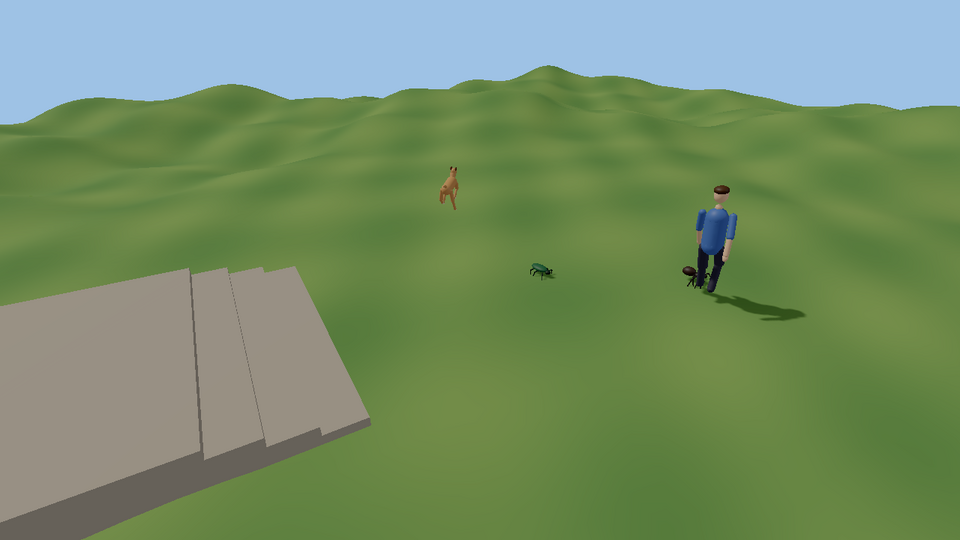
games/procedural_demo (no Synty assets needed): a spider, a beetle, a dog
and a person, built from generated skeletons with no clips at all, walk over
hills and a flight of steps. Click the ground and everyone comes to the
flag; click the dog or the person to hit them (Shift for a hard hit that
knocks them down; they get up again); click a bug and it runs off. 1 / 2 / 3
make the dog walk, trot or gallop, 0 lets it pick by speed. See its
README for the KKE_PROC_* switches.
In the sandbox, play.stagger and play.lookAt work on placed people
(from a node graph or a Lua script).
Tests
tests/test_procedural_anim.cpp: gait tables (diagonal pairs trot together,
duty factors), Froude gait changes, feet staying planted while in stance,
steps landing on raised ground, body pitch on a slope, look-at limits and
give-up, FABRIK reach and bone lengths, masked and additive blending, the
active ragdoll state machine, and the Jolt motor drive holding a limb on
target, a ball joint reaching its target, and a motor-driven character
staying up where a limp one falls (tests/test_jolt_ragdoll.cpp). The play
blocks are covered in tests/test_node_graph.cpp
(ShoveAndLookAtWorkWithAnyWorld).