Algorithms
Classic game algorithms, each in one Lua file you can read top to bottom: a maze generator, terrain from noise, A* pathfinding and flocking. They build with physics boxes and balls so you can walk into the result.
Maze generation
The recursive backtracker (a depth-first search): start in a corner, step to a random neighbour you haven't visited, knocking down the wall between, and when every neighbour is visited, back up until one isn't. The result has exactly one path between any two cells. M makes a new one; the entrance faces where the player starts.
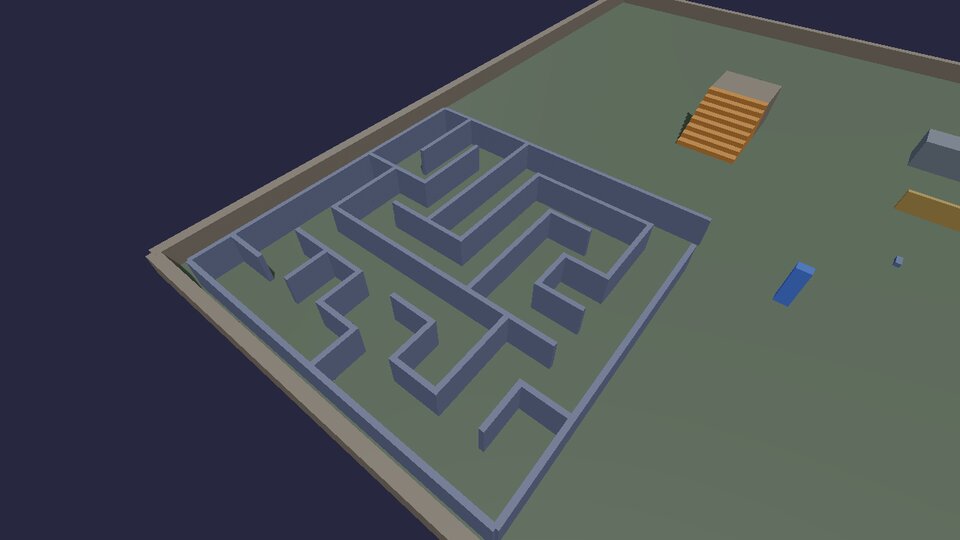
-- maze.lua: a new maze every time you press M. The recursive backtracker:
-- walk from cell to random unvisited cell, knocking down the wall between,
-- and back up when stuck. Every cell ends up reachable, by exactly one
-- path. (docs/cookbook/algorithms.md)

local W, H = 8, 8               -- cells across and deep
local CELL = 1.8                -- metres
local ORIGIN = Vec(-18, 0, 5)   -- the maze's corner in the level
local WALL_H, THICK = 1.4, 0.2

local walls = {}                -- body ids, to clear the old maze
local seed = 7

local function generate()
  math.randomseed(seed)
  -- open[x][z] = { east = bool, south = bool }: the walls knocked down.
  local open, visited = {}, {}
  for x = 1, W do
    open[x], visited[x] = {}, {}
    for z = 1, H do open[x][z] = { east = false, south = false } end
  end

  local stack = { { 1, 1 } }
  visited[1][1] = true
  while #stack > 0 do
    local x, z = stack[#stack][1], stack[#stack][2]
    -- The neighbours not visited yet.
    local choices = {}
    if x > 1 and not visited[x - 1][z] then table.insert(choices, { x - 1, z }) end
    if x < W and not visited[x + 1][z] then table.insert(choices, { x + 1, z }) end
    if z > 1 and not visited[x][z - 1] then table.insert(choices, { x, z - 1 }) end
    if z < H and not visited[x][z + 1] then table.insert(choices, { x, z + 1 }) end
    if #choices == 0 then
      table.remove(stack)              -- dead end: back up
    else
      local n = choices[math.random(#choices)]
      local nx, nz = n[1], n[2]
      -- Knock down the wall between (x, z) and (nx, nz).
      if nx > x then open[x][z].east = true
      elseif nx < x then open[nx][z].east = true
      elseif nz > z then open[x][z].south = true
      else open[x][nz].south = true end
      visited[nx][nz] = true
      table.insert(stack, { nx, nz })
    end
  end
  return open
end

local function wall(cx, cz, sx, sz)
  table.insert(walls, physics.box { pos = ORIGIN + Vec(cx, WALL_H / 2, cz), size = Vec(sx, WALL_H, sz),
                                    color = Vec(0.45, 0.5, 0.65), static = true })
end

local function build()
  for _, id in ipairs(walls) do physics.remove(id) end
  walls = {}
  local open = generate()
  -- The outer walls, with a way in at the east side of the first row.
  wall(W * CELL / 2, 0, W * CELL, THICK)                         -- north
  wall(W * CELL / 2, H * CELL, W * CELL, THICK)                  -- south
  wall(0, H * CELL / 2, THICK, H * CELL)                         -- west
  wall(W * CELL, (H * CELL + CELL) / 2, THICK, (H - 1) * CELL)   -- east, minus the entrance
  -- Inside: each cell's east and south wall, unless knocked down.
  for x = 1, W do
    for z = 1, H do
      if x < W and not open[x][z].east then wall(x * CELL, (z - 0.5) * CELL, THICK, CELL + THICK) end
      if z < H and not open[x][z].south then wall((x - 0.5) * CELL, z * CELL, CELL + THICK, THICK) end
    end
  end
  print(string.format("Maze %d: %d walls", seed, #walls))
end

build()
input.define("maze.new", "New maze", "M")
hook.Add("Think", "maze.keys", function()
  if input.pressed("maze.new") then seed = seed + 1; build() end
end)
- The "recursion" is a list used as a stack:
table.insertpushes,table.removepops. It never runs out of stack however big the maze. math.randomseed(seed)makes the same seed give the same maze: handy for levels you want to share as a number.- Each cell only draws its east and south wall; the outer walls close the rest. That avoids placing every inside wall twice.
Terrain from noise
Value noise gives smooth random numbers across the ground: a random height at each whole-number point, eased between them. Adding a few layers of it, each twice as detailed and half as strong (fractal noise, or fBm), looks like hills. Height picks the colour: water, grass, rock, snow. N makes a new landscape.
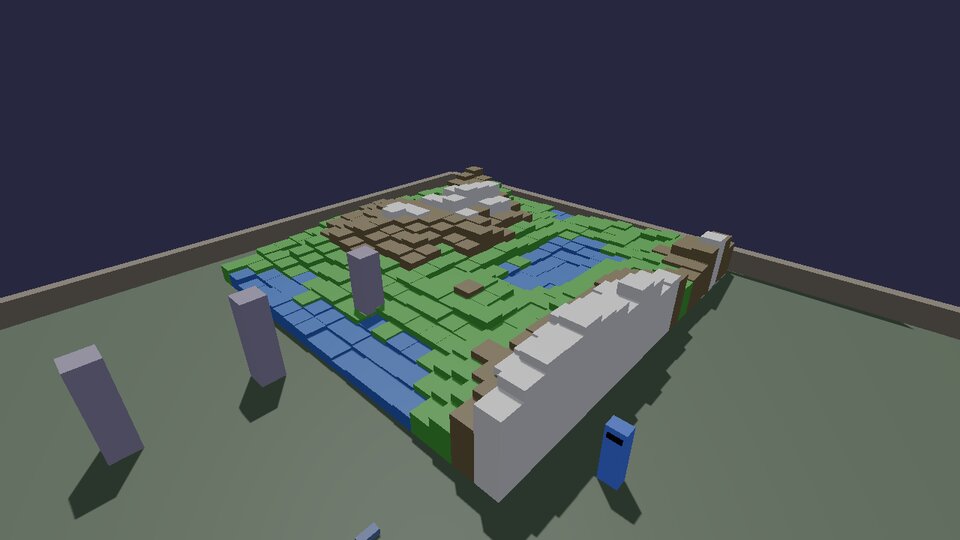
-- terrain.lua: hills from noise. Value noise gives smooth random numbers
-- over the ground; adding a few layers of it at different sizes (fractal
-- noise) looks like terrain. Each column's height and colour come from
-- it. N makes a new landscape. (docs/cookbook/algorithms.md)

local N = 20                    -- columns across and deep
local STEP = 0.8                -- metres per column
local ORIGIN = Vec(2, 0, 4)
local columns = {}
local seed = 1

-- A fixed random number for each whole-number grid point (a hash).
local function lattice(ix, iz)
  local h = (ix * 374761393 + iz * 668265263 + seed * 1442695041) % 2147483647
  h = (h * h * 15731 + 789221) % 2147483647
  return (h % 10000) / 10000     -- 0 .. 1
end

local function smooth(t) return t * t * (3 - 2 * t) end   -- eases in and out

-- Value noise: blend the four grid points around (x, z).
local function noise(x, z)
  local ix, iz = math.floor(x), math.floor(z)
  local fx, fz = smooth(x - ix), smooth(z - iz)
  local a, b = lattice(ix, iz), lattice(ix + 1, iz)
  local c, d = lattice(ix, iz + 1), lattice(ix + 1, iz + 1)
  local top = a + (b - a) * fx
  local bottom = c + (d - c) * fx
  return top + (bottom - top) * fz
end

-- Fractal noise: big gentle hills plus smaller and smaller bumps.
local function fbm(x, z)
  local sum, amp, freq, total = 0, 1, 1, 0
  for _ = 1, 4 do
    sum = sum + noise(x * freq, z * freq) * amp
    total = total + amp
    amp, freq = amp * 0.5, freq * 2
  end
  return sum / total              -- 0 .. 1
end

local function build()
  for _, id in ipairs(columns) do physics.remove(id) end
  columns = {}
  for x = 0, N - 1 do
    for z = 0, N - 1 do
      local h = fbm(x * 0.15, z * 0.15)
      local height = 0.2 + h * h * 4                      -- squared: flatter valleys, sharper peaks
      local color
      if h < 0.35 then color = Vec(0.2, 0.45, 0.8)         -- water
      elseif h < 0.55 then color = Vec(0.35, 0.65, 0.3)    -- grass
      elseif h < 0.7 then color = Vec(0.5, 0.45, 0.35)     -- rock
      else color = Vec(0.95, 0.95, 0.97) end               -- snow
      table.insert(columns, physics.box { pos = ORIGIN + Vec(x * STEP, height / 2, z * STEP),
                                          size = Vec(STEP, height, STEP), color = color, static = true })
    end
  end
end

build()
input.define("terrain.new", "New terrain", "N")
hook.Add("Think", "terrain.keys", function()
  if input.pressed("terrain.new") then seed = seed + 1; build() end
end)
latticeis a hash: the same grid point always gives the same number, so the terrain doesn't depend on the order it's built in.smooth(smoothstep) is what hides the grid: without it, the slopes have visible creases at every grid line.- Squaring the height before using it flattens the valleys and sharpens
the peaks. Try
h ^ 3, or1 - math.abs(2 * h - 1)for ridges.
A* pathfinding
A* finds the shortest way around walls. It explores cells cheapest-first, where a cell's cost is the steps taken to reach it plus a guess at the steps left. As long as the guess never overestimates (here: the Manhattan distance, which ignores walls), the first path it finds to the goal is a shortest one. The red ball re-plans twice a second as you move, and the yellow dots show its plan.
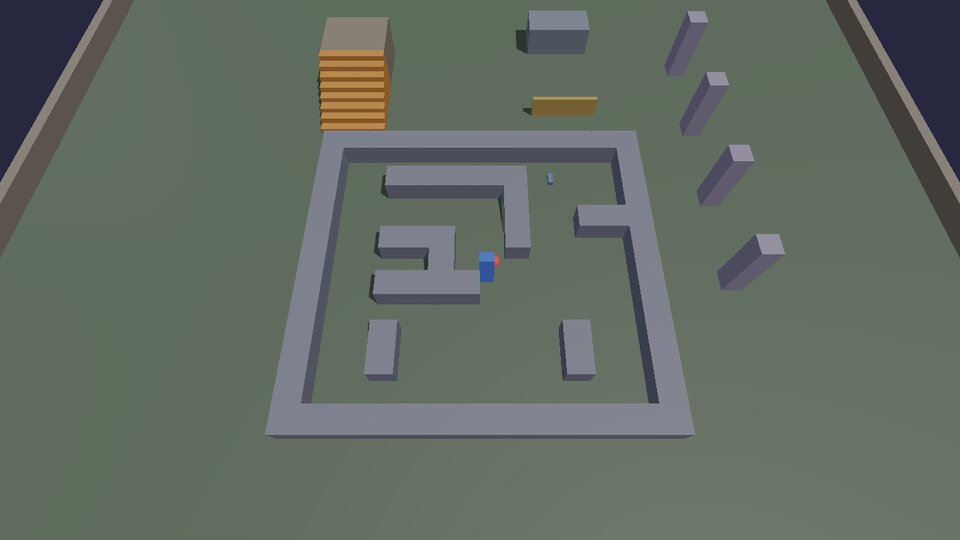
-- astar.lua: a chaser that finds its way to you around walls with A*
-- (A-star), the path-finding most games use. The map is text; the path
-- it plans is shown as dots and re-planned twice a second as you move.
-- (docs/cookbook/algorithms.md)

local MAP = {
  "##############",
  "#............#",
  "#..######....#",
  "#.......#....#",
  "#.......#..###",
  "#..###..#....#",
  "#....#.......#",
  "#..####......#",
  "#............#",
  "#..#......#..#",
  "#..#......#..#",
  "#............#",
  "##############",
}
local ORIGIN = Vec(-7, 0, -1)   -- world position of the map's top-left cell
local SPEED = 3.5

local W, H = #MAP[1], #MAP
local function wallAt(x, z) return MAP[z]:sub(x, x) == "#" end
local function cellOf(p) return math.floor(p.x - ORIGIN.x) + 1, math.floor(p.z - ORIGIN.z) + 1 end
local function centre(x, z) return ORIGIN + Vec(x - 0.5, 0, z - 0.5) end

for z = 1, H do
  for x = 1, W do
    if wallAt(x, z) then
      physics.box { pos = centre(x, z) + Vec(0, 0.5, 0), size = Vec(1, 1, 1), color = Vec(0.5, 0.52, 0.6), static = true }
    end
  end
end

-- A*: explore cells cheapest-first, where cost = steps so far (g) plus a
-- guess of the steps left (h, the Manhattan distance, never too high).
local function findPath(sx, sz, gx, gz)
  local function key(x, z) return z * 1000 + x end
  local open = { { x = sx, z = sz, g = 0, f = math.abs(gx - sx) + math.abs(gz - sz) } }
  local came, best = {}, { [key(sx, sz)] = 0 }
  while #open > 0 do
    -- Take the open cell with the lowest f (a heap is faster for big maps).
    local bi = 1
    for i = 2, #open do if open[i].f < open[bi].f then bi = i end end
    local cur = table.remove(open, bi)
    if cur.x == gx and cur.z == gz then
      local path, k = {}, key(gx, gz)       -- walk back from the goal
      while k do
        table.insert(path, 1, { x = k % 1000, z = k // 1000 })
        k = came[k]
      end
      return path
    end
    for _, d in ipairs({ { 1, 0 }, { -1, 0 }, { 0, 1 }, { 0, -1 } }) do
      local nx, nz = cur.x + d[1], cur.z + d[2]
      if nx >= 1 and nx <= W and nz >= 1 and nz <= H and not wallAt(nx, nz) then
        local g = cur.g + 1
        local k = key(nx, nz)
        if best[k] == nil or g < best[k] then
          best[k], came[k] = g, key(cur.x, cur.z)
          table.insert(open, { x = nx, z = nz, g = g, f = g + math.abs(gx - nx) + math.abs(gz - nz) })
        end
      end
    end
  end
  return nil   -- no way through
end

local chaser = physics.sphere { pos = centre(2, 2) + Vec(0, 0.4, 0), radius = 0.3, density = 300, color = Vec(0.95, 0.3, 0.3) }
local path, dots = nil, {}

local function showPath()
  for _, id in ipairs(dots) do physics.remove(id) end
  dots = {}
  for _, c in ipairs(path or {}) do
    table.insert(dots, physics.sphere { pos = centre(c.x, c.z) + Vec(0, 0.05, 0), radius = 0.06,
                                        color = Vec(1, 0.8, 0.3), static = true })
  end
end

local function plan()
  local cx, cz = cellOf(physics.position(chaser))
  local px, pz = cellOf(player.position())
  if px < 1 or px > W or pz < 1 or pz > H or wallAt(px, pz) then path = nil
  else path = findPath(cx, cz, px, pz) end
  showPath()
end

timer.Create("astar.plan", 0.5, 0, plan)   -- the first plan in half a second

hook.Add("Think", "astar.chase", function()
  local v = physics.velocity(chaser)
  if not path or #path < 2 then
    physics.setVelocity(chaser, Vec(0, v.y, 0))
    return
  end
  -- Head for the next cell on the path; drop cells as they're reached.
  local at = physics.position(chaser)
  local goal = centre(path[2].x, path[2].z)
  local to = Vec(goal.x - at.x, 0, goal.z - at.z)
  if to:length() < 0.2 then table.remove(path, 1) return end
  local step = to:normalized() * SPEED
  physics.setVelocity(chaser, Vec(step.x, v.y, step.z))
end)
- The map is text, so you can draw a level in the file.
#is a wall. - Picking the lowest
fby looking through every open cell is fine for a few hundred cells; for big maps use a binary heap. - To allow diagonal steps, add the four diagonal directions with a cost of 1.414 and use the octile distance as the guess.
- Following the path is the patrol recipe with the path as its waypoints.
Flocking
Craig Reynolds' boids (1986): each ball looks only at its neighbours and follows three rules. Separation: don't crowd them. Alignment: head the way they're heading. Cohesion: move toward their middle. Together they flock like birds or fish. These also keep inside a pen and drift after you.
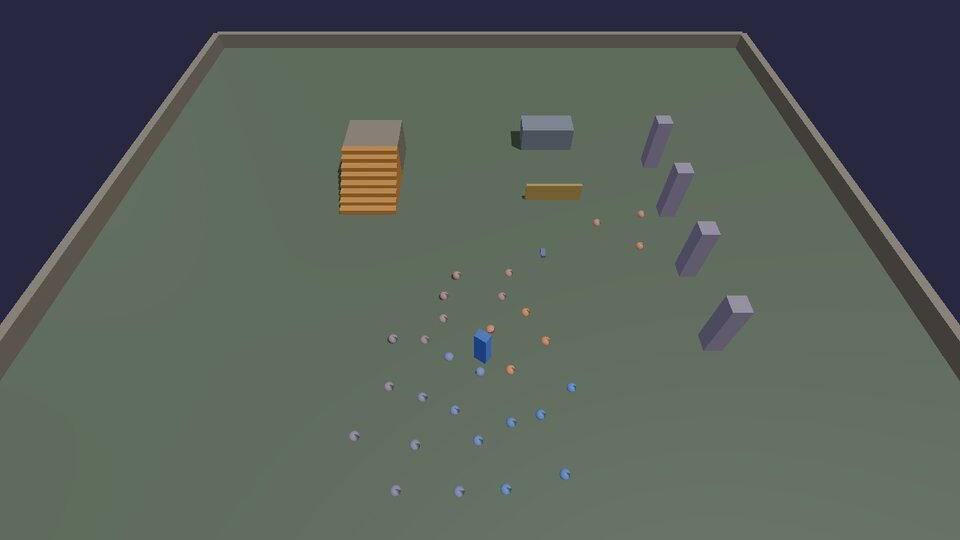
-- flocking.lua: boids. Thirty balls that flock like birds or fish from
-- three simple rules, each looking only at its neighbours: don't crowd
-- (separation), go the way they go (alignment), stay with them
-- (cohesion). They also keep inside a pen and drift after you.
-- (docs/cookbook/algorithms.md)

local COUNT = 30
local SEE = 2.5             -- how far a boid sees its neighbours, metres
local SPEED = 3
local PEN_MIN, PEN_MAX = Vec(-12, 0, -12), Vec(12, 0, 12)

local boids = {}
for i = 1, COUNT do
  local a = i / COUNT * math.pi * 2
  table.insert(boids, physics.sphere { pos = Vec(math.cos(a) * 4, 0.3, math.sin(a) * 4), radius = 0.2, density = 100,
                                       friction = 0, color = Vec(0.3 + 0.7 * i / COUNT, 0.6, 1 - 0.6 * i / COUNT) })
end

hook.Add("Think", "flocking.update", function(dt)
  -- Read everyone first, then move: every boid reacts to the same moment.
  local pos, vel = {}, {}
  for i, id in ipairs(boids) do
    local p, v = physics.position(id), physics.velocity(id)
    pos[i], vel[i] = Vec(p.x, 0, p.z), Vec(v.x, 0, v.z)
  end
  local me = player.position()

  for i, id in ipairs(boids) do
    local apart, heading, middle, n = Vec(0, 0, 0), Vec(0, 0, 0), Vec(0, 0, 0), 0
    for j = 1, COUNT do
      if j ~= i then
        local offset = pos[i] - pos[j]
        local d = offset:length()
        if d < SEE and d > 0.001 then
          apart = apart + offset / (d * d)       -- closer pushes harder
          heading = heading + vel[j]
          middle = middle + pos[j]
          n = n + 1
        end
      end
    end
    local steer = Vec(0, 0, 0)
    if n > 0 then
      steer = steer + apart * 1.5                              -- separation
      steer = steer + (heading / n - vel[i]) * 0.5             -- alignment
      steer = steer + (middle / n - pos[i]) * 0.4              -- cohesion
    end
    steer = steer + (Vec(me.x, 0, me.z) - pos[i]):normalized() * 0.3   -- drift toward you
    -- The pen: turn back near its edges.
    if pos[i].x < PEN_MIN.x then steer = steer + Vec(3, 0, 0) end
    if pos[i].x > PEN_MAX.x then steer = steer - Vec(3, 0, 0) end
    if pos[i].z < PEN_MIN.z then steer = steer + Vec(0, 0, 3) end
    if pos[i].z > PEN_MAX.z then steer = steer - Vec(0, 0, 3) end

    local v = vel[i] + steer * (dt * 4)
    if v:length() > SPEED then v = v:normalized() * SPEED end
    physics.setVelocity(id, Vec(v.x, physics.velocity(id).y, v.z))
  end
end)
- The weights (1.5, 0.5, 0.4) set the character: more separation is a loose swarm, more cohesion a tight school, more alignment a stream.
- Every boid reads every other one, so 30 boids is 870 checks a frame. For hundreds, put them in a grid of cells and only check the neighbouring cells.
Next: animation and IK.