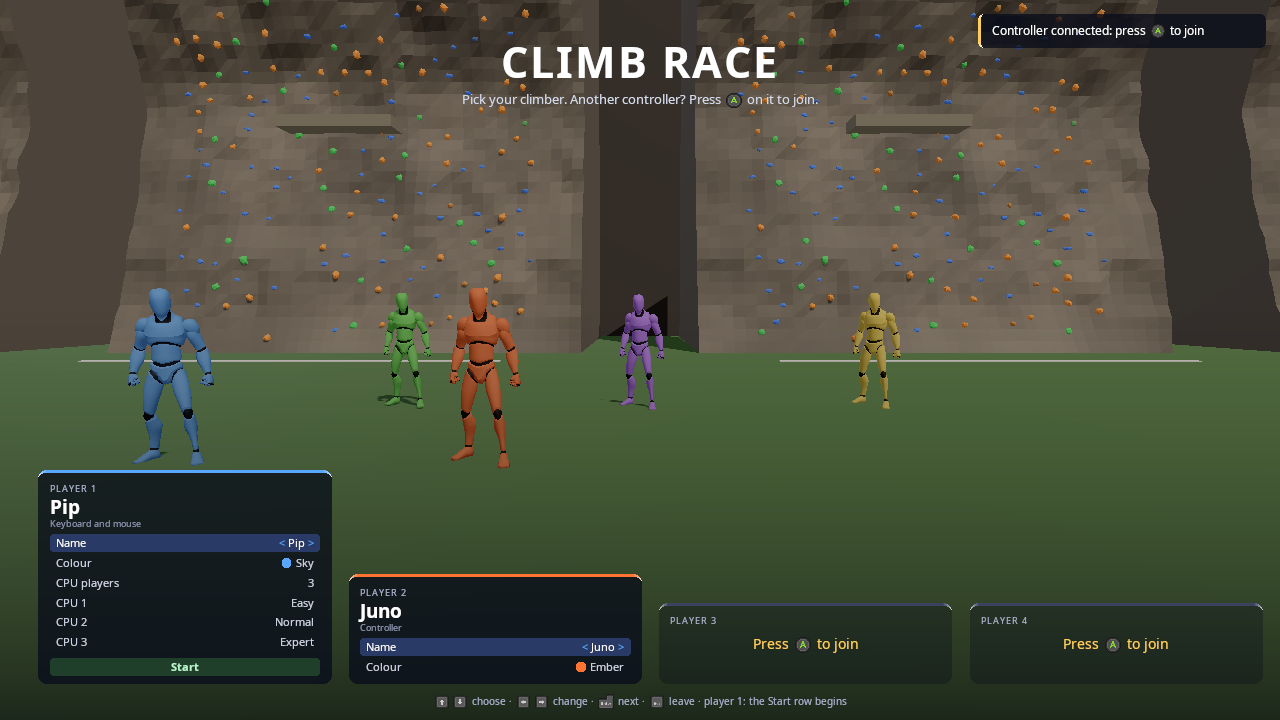
The start menu: players join, pick a look, set the CPU players
kke::LobbyModule is the menu a local multiplayer game starts on. Every
controller that presses A joins, each player picks how they look, and
player 1 sets how many CPU players there are (0 to 5) and how good each one
is. During the game a controller that is plugged in gets a toast,
"Controller connected: press A to join", instead of a key or a command
turning split screen on. Climb Race (games/climb_race) uses it.
How it plays
- Player 1 is always in. Until they press something they are "any device"; the first controller or key they press on becomes theirs ("press A or Enter").
- Joining. Any other controller pressing A (the south face button: Cross on a PlayStation pad) takes the next free seat, up to four. When player 1 is on a controller, Enter on the keyboard joins too. B (Esc) leaves the seat.
- Picking. Each seat has a cursor: up and down choose a row, left and right change it, A moves on. The rows are the game's look fields (Climb Race: name and colour). Player 1's card also has the game's settings: CPU players, the difficulty of each (Easy, Normal, Hard, Expert), any rows other modules add, and Start. Start on player 1's controller starts from any row. A finger (or the mouse) taps a row instead: a value steps on (the left half of the value steps back), an action row or Start is pressed, and a key of the on-screen keyboard types (TOUCH.md).
- Hot-plugging. A controller plugged in shows a toast with its own button (Xelu glyphs, INPUT.md "Button prompts"). One that belongs to a player and comes loose keeps its seat ("Juno's controller is unplugged") and carries on when it's back.
- During the game the menu is closed, but a free controller pressing A still joins. The game decides when they come in (Climb Race: the next race; the toast says so).
- Looks and settings are saved (
<game>_lobby.json, or.yml: see DATA_FILES.md) when the game starts from the menu, and loaded next time. Controllers are not saved: they're claimed again.
Using it in a game
// main.cpp: after InputModule and UiModule
app.addModule<kke::LobbyModule>("my_game_lobby.json");

// the game's init()
m_lobby = app.getModule<kke::LobbyModule>();
kke::Lobby& l = m_lobby->lobby();
l.addLookField({ "name", "Name", { "Pip", "Juno", "Rook" }, {} });
l.addLookField({ "colour", "Colour", { "Sky", "Ember" }, { { 0.35f, 0.65f, 1.0f }, { 1.0f, 0.45f, 0.2f } } });
l.setCpuCount(1);                  // the default, before load()
m_lobby->load();                   // last time's looks and settings
m_lobby->setTitle("MY GAME", "Another controller? Press {a} on it to join.");

// every frame while the menu is up: draw the players behind it, then
if (l.takeStart()) {
    m_lobby->close();
    m_lobby->save();
    m_lobby->applyInput();         // one InputModule player per seat, on its own devices
    for (int seat : l.joinedSeats()) spawnPlayer(seat, m_lobby->playerOf(seat), l.seat(seat).look);
    for (int i = 0; i < l.cpuCount(); ++i) spawnCpu(l.cpuDifficulty(i));
}
// back to the menu
m_lobby->open();
- A look field with
id"name"names the seat (seatName); a field with swatches colours the card's top edge. setMaxCpus(0)hides the CPU rows;setDifficulties({...})renames or adds levels (the game decides what each one means).addOption({ id, label, choices, value, visible, onPress, onChange })adds a row to player 1's settings, before Start: with choices it's a value (left / right), without it's an action (A presses it). Climb Race adds Online (Off / Join / Host), Game and Join this way (games/climb_race/Net.cpp, docs/NETWORKING.md "In Climb Race"). Setvisibleto show a row only when it applies;setTitleredraws them.addTextOption(id, label, placeholder, onDone)adds a row player 1 types into: an address or a join code. A on it opens an on-screen keyboard (d-pad moves, A types, B deletes, Start is Done); on the keyboard they just type (Ctrl+V pastes, Enter keeps it, Esc puts back what was there). Only what an address or a code can hold is kept (letters, digits,. : - _ @ [ ]).onDonegets the text when they finish;text(id)reads it any time. It's saved in the lobby file with the other options, even when the row is added afterload(). Every online demo has one, "Address or code", under Online = Join: it joins throughNetModule::joinTyped(an IP or name,:portoptional, or a join code), for when the search finds nothing (two different networks with no VPN between them; LANs and VPNs are searched, see NETWORKING.md "Finding games").- The game shell (
kke::GameShellModule, GAME_SHELL.md) adds a "Settings and quit" row, and Select opens its pause menu over the lobby; the lobby stops listening while that menu is open. onJoin/onLeaveare called with the seat.- Flight sticks and other joysticks stay out of the menu unless the game
calls
m_lobby->setFlightSticks(true): then a stick's trigger joins (button 1 confirms, button 2 goes back, the hat or the stick moves), and its card says "Flight stick:". The Flying demo does this. l.setSeatDevice(seat, device, pad)moves a joined seat to another device: false when another seat holds it (a device is never shared), true when it's free or already theirs.seatOfDevice(device, pad)says who holds one. The Flying demo's pause menu is built on these (games/flying_demo/Players.cpp); LobbyModule hands the seat's input map its new device on the next frame.- The title and the subtitle take button prompts:
{a},{start},{jump}(ButtonPrompts::format). kke::Lobbyis pure logic (no window, no SDL), so it's unit-tested (tests/test_lobby.cpp); LobbyModule turns real devices into its presses and shows it with RmlUi.
Online
In a network game (NetModule, docs/NETWORKING.md) the menu also lists
everyone on the other machines, on the left ("Online in this game"):
their name, HOST or CPU, and what they picked, in their colour. The host
sees each player who joins the moment they're in, and a joiner sees the
host's players. When someone changes a look in their menu, every screen
shows it.
This works when the game sends its lobby look as the NetModule
character: lobby().lookText(seat) ("look:2.4", the choice numbers)
and, after a |, anything of the game's own ("look:2.4|cpu,#5aa6ff").
lookFromText(character) reads the choices back (one per look field,
out of range or missing ones as 0), characterExtra(character) gives
the game's part, and lookChoice(look, field) a choice's name. Every
machine runs the same game, so the numbers mean the same everywhere.
LobbyModule fills lobby().onlinePlayers() itself each frame; a game
whose character is "cpu" or ends in "|cpu..." is tagged CPU.
The games also put the other screens' players into the scene behind the menu: Climb Race and Party line them up at the back of the stage, Racing parks their cars on the grid as they picked them.
Testing without controllers
| Variable | Effect |
|---|---|
KKE_VIRTUAL_INPUT=pad,pad,pad |
Three virtual gamepads (one per pad) |
KKE_LOBBY_JOIN=<n> |
The first n controllers join as players 2.. at startup (player 1 takes the keyboard) |
KKE_VIRTUAL_INPUT_LATE=<s>:pad |
A gamepad plugged in s seconds in: the "press A to join" toast |
All three are developer switches: shipping builds ignore them.
cd build/bin
KKE_SKIP_INTRO=1 KKE_VIRTUAL_INPUT=pad,pad,pad KKE_LOBBY_JOIN=2 KKE_VIRTUAL_INPUT_LATE=12:pad ./climb_race
shows the Climb Race menu with three players, and the toast twelve seconds in.